Saturday, April 23, 2016

Ladybug and Butterfly by iPhone

I am still learning how to take photos with my first smart phone, but I am getting better. With patience and the instant feedback that you get from all digital cameras, it is possible to know immediately whether you captured the target wildlife or not. Unfortunately, for me, phone cameras produce so much glare on the screen that it is still very difficult to know if a shot is worth anyone else's time looking at it. That usually isn't discernible until you get home and upload to a computer. It is still hard for me to steady a hand-held iPhone to do a close-up of insects. The clarity achieved by shooting down on the ladybug exceeds that of shooting up to capture the butterfly. Still I am pleased with both efforts, especially the butterfly shot. Let's see what you think.

Photo taken at Blue Sky Ecological Reserve
Photo taken at Los Peñasquitos Canyon Preserve


Friday, April 22, 2016

Mallard Duck Tracks at Miramar Lake

Recently while at the lake, I stopped to video these mallards that were busy wandering around near picnic tables and people areas. In the soft dusty soil, bird prints abound, and in the attached video you can see them being made by two birds out for a day together.


Wednesday, March 30, 2016

Ground Squirrel and Tracks at the Beach


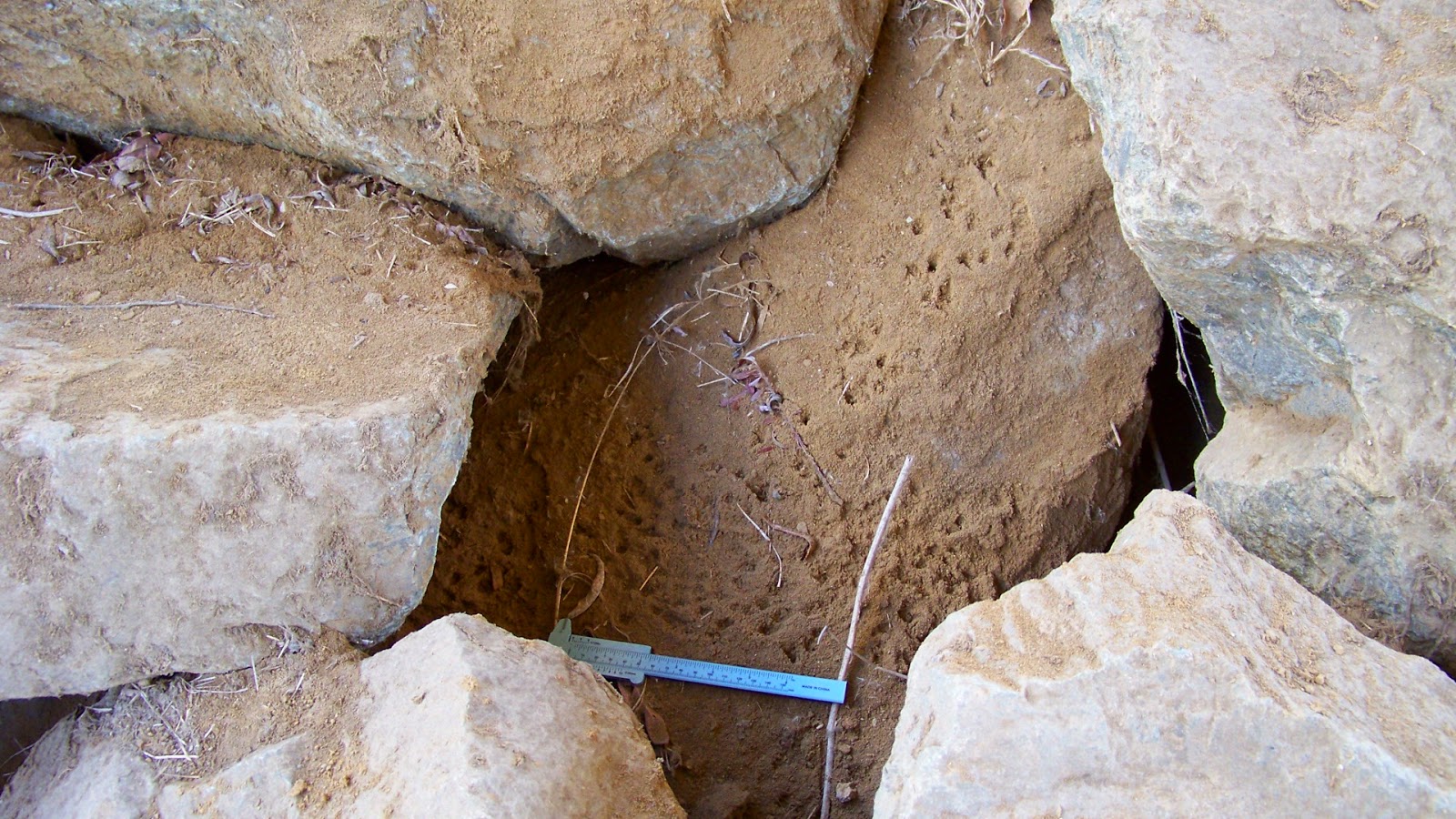
Sometimes having both an image of the animal and its footprints help me to better develop a sense of the animal. That, for me, is what tracking is about - envisioning the animal that was here before me and left its signs.

I joined the San Diego Tracking Team so that I could learn to appreciate my local surroundings more. Indeed, San Diego rewards those who seek wildlife knowledge. As with our subtle seasons, San Diego has much to offer naturalists. We have very diverse habitats abundant with plants, animals, and terrain to challenge and amuse. Today I can be nearly overwhelmed by the cacophony of bird calls, insect hums and buzzes, and the innumerable scents and colors of flora that abound in southern California.    


This ground squirrel was shot last year on Mother's Day at a mobbed La Jolla Shores beach area. The footprints were taken further up the coast later in the year at an intensive tracking training workshop north of Torrey Pines State Park. The footprints were left by a busy ground squirrel scurrying among boulders and checking out possible human food tidbits left behind by a family that was enjoying a day at the beach. 

Thursday, October 22, 2015

Snowy Egret at Miramar Lake, San Diego

Sometimes I travel a great distance to see wildlife, but it's really all around us in San Diego. One of the local gems in my community is Miramar Lake.  On a recent visit, I was focused on birds and was delighted to capture this Snowy Egret foraging for food in the shallows at the edge of the reservoir. In the top photo, the egret had been stalking fish, I presume, but when I looked at this photo, the bird's neck or skin under the neck seemed to be either filled with something, inflated, or bunched up under the head. It could also have been a strange camera angle; the bird was on the move when I took the shot. Did he catch something and swallow it? Also, it appears that the other birds are respectful of the egret although I never saw it attack another animal.  


Thursday, August 13, 2015

Mother Moose with Offspring, Pinedale, Wyoming

This summer we discovered by accident the CCC camp outside Pinedale, Wyoming, en route back to Salt Lake City, Utah. This wonderful park (Fremont Camp) has several short trails that go around various pond settings. Because I was not familiar with a marsh habitat, I chose to walk the Marsh Trail. In June, it was a bit buggy with mosquitoes, but it was well worth the itchy bites. The highlight came at the end of our walk when my husband and I were almost to the parking lot area. Above you can see our prize view of a mother moose with her youngster feeding in the Marsh Pond!

After creating my own YouTube video, I found another very informative one on Sublette County and Pinedale, Wyoming. This area is definitely worth a return visit - and you might even want to skip Yellowstone's crowds and instead go hiking and fishing in "real" cowboy country.

Monday, March 23, 2015

Bighorn Sheep at Anza Borrego - Walking Gait and Foraging

In my focus on tracking wildlife, sometimes I forget to look for the living animals that make the signs I look at. These days I pause much more to listen for unusual and identifiable sounds (in Palomar Mountain State Park recently, I was able to hear wild turkeys calling though I couldn't see them across the valley) and to see some of the wildlife I've never seen before. I previously posted some views of Bighorn sheep, and here are a few other videos of the sheep in action by the parking lot at Anza Borrego State Park. This one is of the walking gait of Bighorn Sheep on the desert floor, and the following one is of bighorn sheep foraging. Hope you enjoy these views - my first at close range.


After the sheep left, my husband and I did try to make out tracks in the sand, but other than having just seen the sheep walking there, it was virtually impossible with our still unskilled eyes to recognize the sand indentations as sheep vs. any other kind of animal. I'll keep practicing, though.

Monday, March 16, 2015

Even the Sure-Footed Slip…


Here is some footage I was lucky to capture. A tired mama bighorn sheep comes back from a foraging bout to feed her lamb. She was clearly laboring as she zigzagged up the canyon wall to a safe location where her lamb bounced down the slope to nurse briefly.

On the Trail of Bighorn Sheep

Anza Borrego Desert State Park has long been a favorite outdoor site to visit in March. Though I've been going there every spring for decades, I have never seen the famous bighorn sheep. Usually I am more focused on the smaller wildlife and spring wildflowers. However, recently, I was treated to an up-close and personal encounter with a small herd of these endangered animals (Ovis canadensis nelsoni) plus viewings of two other herds at different locations along the Palm Canyon trails.
Where are the Waldos?

Vigilant but habituated to people
Yum…  
This shot was taken facing the eastern canyon wall of the park. The sheep were resting high up the slope. There are at least five youngsters clearly visible in this shot (Kodak Easy Share Z1012 IS, 12X). The occasional ear twitches were the primary way that park visitors were able to locate them. Mother Nature did a great job of camouflaging this species.Down below in the lower parking lot for campers and visitors to Palm Canyon (the west side), my husband and I saw a few sheep coming down the slope to feed. I took a position with my camera and waited to see if the sheep would come my way.  They did!  These two rams came within 25 to 30 feet of my position. They kept an eye on me, frequently pausing between chews to look straight at me.As more of the herd came to the canyon bottom to feed, I began to fear that one would come up next to me without my spotting him/her. I determined that I should not move or react suddenly at any time. After several minutes, the herd of about 10 animals took off in a gallop across the parking lot through some high bush.Truly an amazing experience!

Enjoy!

Friday, January 23, 2015

Animal Tracks Under an Overpass


Under the overpass of Sorrento Valley Boulevard above Los Peñasquitos Canyon Preserve, there were many more treasured footprints including my first clear bobcat prints. There are also some bird and raccoon tracks evident. I am still trying to figure out the very small sets of tracks. If you can identify, comments are welcome. 

 
Bobcat
             

Raccoon
Small deer? over cricket

Mouse?


Mystery feet

Wednesday, January 21, 2015

Tracking the wild beetle, earthworm, and snail

 
Recently, we went on a tracking "expedition" starting at the west end of Los Peñasquitos Canyon Preserve, San Diego, CA. Right under an overpass,  we found numerous tracks. The top two photos are perhaps of darkling beetles. The middle two show the trail of an earthworm. We estimated one trail to be about seven feet in length. Why would an earthworm cut across a dirt trail? It definitely leaves a distinctive mark, but I would not have imagined this creature was the creator.


Lastly, the trail of a snail! To get this photo, I had to stand in the middle of the road to protect the animal from being run over by the numerous trail bikers cruising along, oblivious to the life forms crushed beneath their wheels. After I moved a short distance down the trail from the worm, it was immediately hit and left writhing on the ground. At least, it is immortalized here on this page.

NB: The following comment was made on FB regarding my guess that the trail in the top two photos was made by a beetle. They could also be tracks of a cricket according to K. C. "Crickets tend to have the middle feet sticking out perpendicular to the trail, rather than at an angle like beetles. That's why I think it's a cricket rather than a beetle." 

Thursday, January 15, 2015

Palomar Mountain State Park, California - The Weir


The Weir (1)


I've been collecting photos of my favorite local mountain retreat over several years. In 2012, Palomar Mountain State Park was scheduled for closure by the state of California. I am so grateful that with the help of many individuals like my family who were willing to put up funds to keep the park maintained, Palomar Mt. State Park managed to stay open.  Then there were the "discovered" funds that helped to bring back all the state parks. Today, we can continue to visit this special spot nestled in the forests of San Diego County. 

The "Weir" is my favorite spot to "hike" to - I say "hike," but it's actually a short 1.2 mile up and down walk along a gently flowing stream to reach this historic spot, travelling through pine, spruce, and oak, out into a small sunlit patch of "beach" near a stream crossing, continuing on to a small cove-like area (see above) which perpetually changes with the month and season. 

This shot was taken in November 2009 in the late fall. As you can see, the fish pool was nearly dry.

In the second photo, you can see how the look of the place can vary depending on the year, too. This shot was taken two years later but about the same time of year in the fall. It looks like we got quite a bit more rain in 2011, or it else it just wasn't as hot in the early fall.

The Weir (2)
In the next set of photos (3), you can see the Weir in the winter. There is still color there, but it is subtle. I lucked out because the sky was clear and bright with some wispy clouds. That wonderful light created outstanding reflections in the Weir.

In the last set of photos (4), you can see the Weir in summer green. Verdant. As you view the Weir in different seasons, I hope you will want to visit and  know this small mountain paradise better. Enjoy the photos! Get up here and see it with your own eyes.

I will be putting up some more photos, to give you an idea of the wildlife you might see or encounter on the trail and what other areas of the park look like.


The Weir (3)


The Weir (4)

Friday, July 4, 2014

Not all Black Bears are Black


While up in Sequoia National Park (NP) last month, we learned that not all black bears are actually black in color. However, all the bear scat we encountered was black!  The big cinnamon-colored bear was the first that we observed from a distance of about 50 yards, and we followed it as it moved down a tree-covered slope. Minutes later, it came out into the open on some large boulders near water. From there we lost sight of the bear, but it seemed to be moving downstream toward the Lodgepole campground.

A few days later we saw this female bear (No. 65) with two youngsters. As you can see, these two also have brown coats. This family of bears foraged in the meadow for a long time, causing a major traffic jam in the park as people stopped their cars in the middle of the road and jumped out to get a photograph or two. The meadow was lush with deep grass (you can see the mother is chewing a huge mouthful), and it was right below the road that runs through the park, opposite the Giant Forest Museum.                          

Friday, June 27, 2014

California Striped Racer + Collared Snake

Photo 1
Photo 2

A few days ago, I saw the tail of a long thin snake twitching outside one of our planters on the decomposed granite (DG). I ran upstairs for my camera (my old digital Kodak Z1012) and was able to get a couple of shots off before the racer quietly slithered off. The snake caught something moments after I got outside to photograph it. The prey looks like another small snake, but it also could have been a lizard. I could see something long and thin hanging from its mouth. However, in the second photograph, I'm unable to see legs on the reptilian form stuck in its mouth. A friend hypothesized that it was another snake, a small collared snake, which in some photos I found online, has the pink to salmon coloration that is visible in the animal being consumed. I did see a very thin coral-colored tail hanging out of the striped racer's mouth after it first struck its prey. I've lived in Southern California all my life, but this is the first striped racer that I've ever seen - and it was in my own backyard!

Thursday, June 26, 2014

Encounter between Black Bears and Deer at Sequoia National Park, June 2014


On June 18, 2014 around 4:30 p.m., my husband and I were on the trail from Tokopah Falls near the Lodgepole campground in Sequoia National Park. There was a small gathering of people watching a black bear with her two cubs feeding in a meadow. As I moved up and down the trail trying to get a good angle to take a photograph of the event, my husband elbowed me and said, "Look! There's a deer!" Indeed, the deer was about six feet away from the trail, but the doe was paying no attention to the viewers. Her attention was fixed on the bears, who were now face down, feeding at the base of a large tree. Moments before the deer's arrival, I had heard some soft cries and thought it was the baby bears crying to their mom….

As you can see in the second photo, the adult deer passed very close to the bears as she circled the tree. At first, she was silent, but after a few circles, she started vocalizing. Clearly, she was in distress. Periodically, she would stop looking off to the left of the scene as if she were waiting for reinforcements. No other deer were to be seen during the 20 minutes that we stayed at the site. The next two videos are of the interaction between the bears and deer. Words are unnecessary to sum up this Life 101 event.


Sunday, May 4, 2014

Joshua Tree National Park, California

Raven taking flight


Blooming chollas!
Mojave? rattler sandwiched between
two boulders after being startled
by a hiker -
about 3.5' above ground